Vintage pattern · 1952 · square flower motif for an afghan
Flower Garden Motif
Free crochet pattern with chart
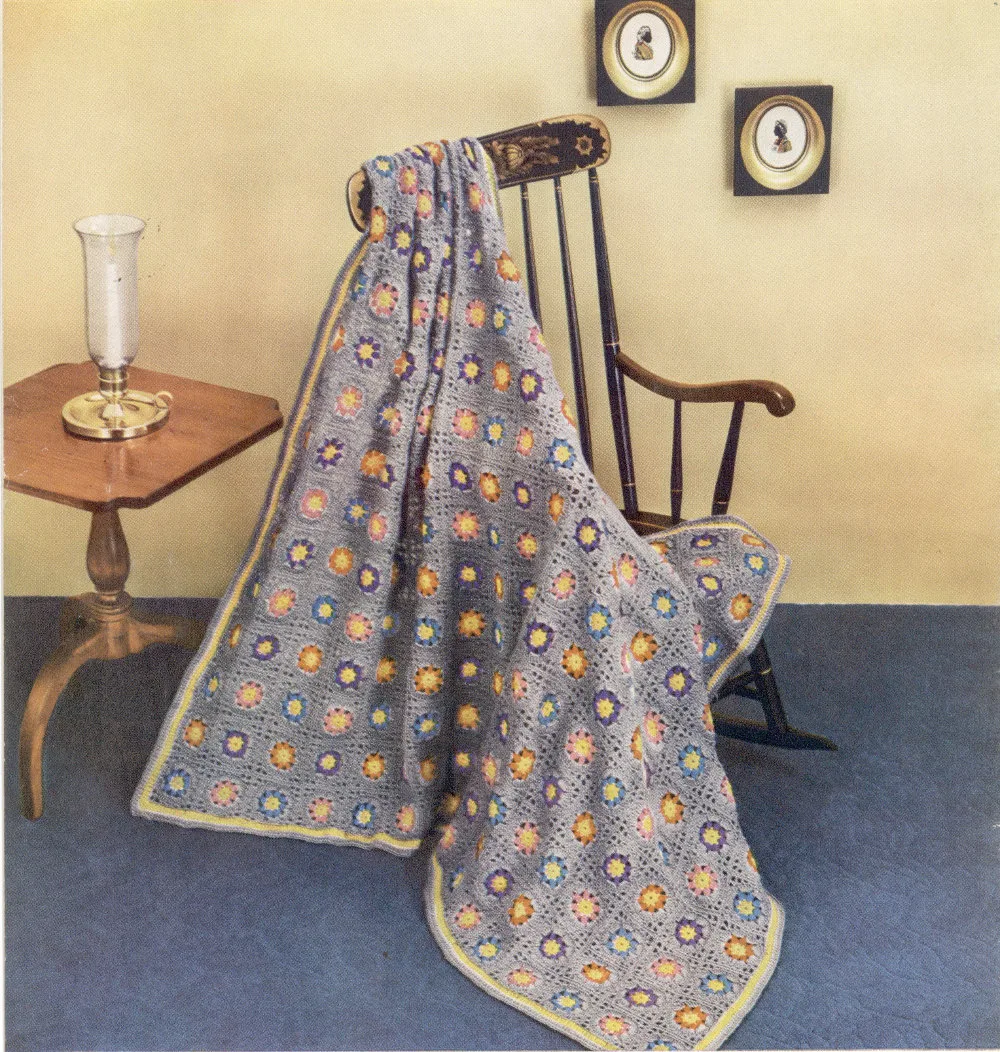
A small square with a flower in the middle, from a 1952 afghan booklet. A yellow center, eight cluster petals in any color you like, and two rounds of gray: one fills in the circle and a lacy one turns it into a square. Each motif is 3 1/4 inches, and 266 of them make the booklet's afghan.
- Yarn
- Worsted (4)knitting worsted in 1952
- Hook
- Plastic No. 5match the gauge
- Finished
- 3 1/4 in square4 rounds
Chart
Flower Garden Motif crochet chart


Reading this chart
- Start at the center and read each round counterclockwise, the way a right-handed crocheter works.
- Start at the center and read each round clockwise, the way a left-handed crocheter works.
- Each round begins at its green mark, its first stitch or chain; its number is printed beside it. Rounds alternate dark and blue so they read apart.
- The key under the chart names every symbol. Symbols follow the Craft Yarn Council chart standard.
Drawn by Krowshea from the checked counts, not traced from the original. New to charts? How to read crochet charts.
Written pattern
Round by round
Written in US crochet terms
- 1
yellow Ch 4 (the 3 skipped ch count as a dc), 15 dc in 4th ch from hook, join with a sl st to the top of the beginning ch-3. Fasten off.
16 dc - 2
rose Join rose, ch 3 (counts as the first dc), then work the bracketed step of the 3-dc cluster twice (not 3 times) in the same st, yarn over and draw through all loops on the hook, [ch 3, sk next st, 3-dc cluster in next dc] 7 times, ch 3, sk next st, join with a sl st to the first st. Fasten off.
8 clusters, 8 sps - 3
gray Join gray in any sp, ch 3 (counts as a dc), 4 dc in same sp, [5 dc in next sp] 7 times, join with a sl st to the top of the beginning ch-3.
40 dc - 4
Ch 3 (counts as a dc), (ch 3, dc) in same st, *ch 1, sk next st, hdc in next dc, [ch 1, sk next st, sc in next dc] 2 times, ch 1, sk next st, hdc in next dc, ch 1, sk next st, vee in next dc; rep from * 2 more times, ch 1, sk next st, hdc in next dc, [ch 1, sk next st, sc in next dc] 2 times, ch 1, sk next st, hdc in next dc, ch 1, sk next st, join with a sl st to the top of the beginning ch-3. Fasten off. For the 1952 afghan: make 266 motifs and sew them neatly together on the wrong side, 14 rows of 19. Border: attach yellow to any corner, ch 3, 4 dc in the same corner, dc closely around with 5 dc in each corner, join and break off. Then with gray, dc in each dc around with 5 dc in the center dc of each corner group. The joining and border are not part of the checked pattern.
8 dc, 8 hdc, 8 sc, 24 sps
Weave in the ends.
Written in UK crochet terms
- 1
yellow Ch 4 (the 3 skipped ch count as a tr), 15 tr in 4th ch from hook, join with a ss to the top of the beginning ch-3. Fasten off.
16 tr - 2
rose Join rose, ch 3 (counts as the first tr), then work the bracketed step of the 3-tr cluster twice (not 3 times) in the same st, yarn round hook and draw through all loops on the hook, [ch 3, miss next st, 3-tr cluster in next tr] 7 times, ch 3, miss next st, join with a ss to the first st. Fasten off.
8 clusters, 8 sps - 3
gray Join gray in any sp, ch 3 (counts as a tr), 4 tr in same sp, [5 tr in next sp] 7 times, join with a ss to the top of the beginning ch-3.
40 tr - 4
Ch 3 (counts as a tr), (ch 3, tr) in same st, *ch 1, miss next st, htr in next tr, [ch 1, miss next st, dc in next tr] 2 times, ch 1, miss next st, htr in next tr, ch 1, miss next st, vee in next tr; rep from * 2 more times, ch 1, miss next st, htr in next tr, [ch 1, miss next st, dc in next tr] 2 times, ch 1, miss next st, htr in next tr, ch 1, miss next st, join with a ss to the top of the beginning ch-3. Fasten off. For the 1952 afghan: make 266 motifs and sew them neatly together on the wrong side, 14 rows of 19. Border: attach yellow to any corner, ch 3, 4 tr in the same corner, tr closely around with 5 tr in each corner, join and break off. Then with gray, tr in each tr around with 5 tr in the center tr of each corner group. The joining and border are not part of the checked pattern.
8 tr, 8 htr, 8 dc, 24 sps
Weave in the ends.
The 1952 original
As it was printed
Afghans · Flower Garden C-127, photo on page 14
MOTIF (Make 266) ... Starting at center with Yellow, ch 4. 1st rnd: 15 dc in 4th ch from hook. Join with sl st to top of ch-3. 2nd rnd: Attach desired color to same place as sl st, ch 3, holding back on hook the last loop of each dc, make 2 dc in same place, thread over and draw through all loops on hook (cluster made), * ch 3, skip next dc, 3-dc cluster in next dc. Repeat from * around. Join to tip of first cluster. Break off. 3rd rnd: Attach Grey to any sp, ch 3, 4 dc in same sp, 5 dc in each remaining sp around. Join. 4th rnd: Ch 5, dc in same place as sl st, * ch 1, skip next dc, half dc in next dc, (ch 1, skip next dc, sc in next dc) twice; ch 1, skip next dc, half dc in next dc, ch 1, skip next dc, in next dc make dc, ch 3 and dc. Repeat from * around. Join and break off. Sew motifs neatly together on wrong side, having 14 rows of 19 motifs.
The 1952 stitch names
The booklet prints its own list of abbreviations, all in modern American terms, so nothing needs translating. Its one special stitch is spelled out in the directions:
| In 1952 | US today | How we know |
|---|---|---|
| cluster | 3-dc cluster | "Holding back on hook the last loop of each dc, make 2 dc in same place, thread over and draw through all loops on hook (cluster made)." |
What we checked
- Round 1: 16 dc.
- Round 2: 8 clusters and 8 ch-3 spaces, a cluster in every other dc.
- Round 3: 40 dc, 5 in each space.
- Round 4: 8 dc, 8 hdc, 8 sc and 24 spaces. Each side uses 10 of the 40 dc.
- The photo shows the same parts as the chart: a round flower with a yellow center in a gray square. It is too small to count stitches.
How we read the old wording
- Round 4 opens "ch 5, dc in same place". We read it as ch 6 (a dc and a ch-3), so the first corner matches the other three; as printed it is one chain shorter.
- The petal color is the maker's choice. Rose is our stand-in.
- Sewing the 266 motifs together and the border are given as a note. They are not part of the checked pattern.
One likely slip in the original: round 4 opens with ch 5 where ch 6 would match the other three corners. We read it as ch 6. Every round closes evenly.
More vintage patterns
-
 1948 · Motifs
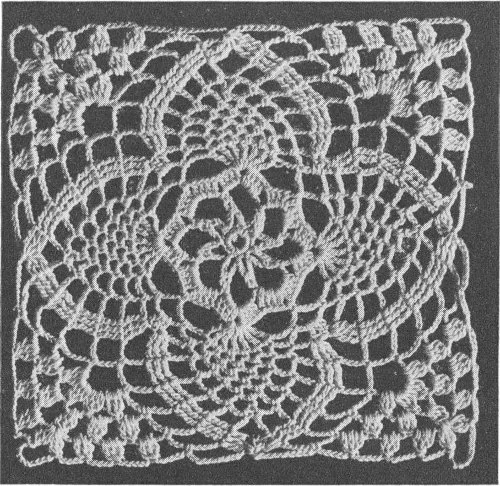
Poinsettia Motif
American Thread Company, New Tablecloths
-
 1948 · Motifs
Pond Lily Motif
American Thread Company, New Tablecloths
-
 1941 · Motifs
Lucky Star Motif
The Spool Cotton Company, Old and New Favorites: Crochet Designs
-
 1941 · Motifs
Pinwheel Motif
The Spool Cotton Company, Old and New Favorites: Crochet Designs
Krowshea is in beta
Make it with Krowshea
This pattern stays free right here. Krowshea members will be able to do more with it:
- Turn it in 3D Yarn and watch it grow round by round
- Save it to your Library and make it your own: new colors, a border, a different size
- Track your rounds with Make it, on your phone
- Open it in the Studio: change the thread, size it up in yarn, join motifs