Vintage pattern · 1948 · thread crochet motif
Daisy Tablecloth Motif
Free crochet pattern with chart
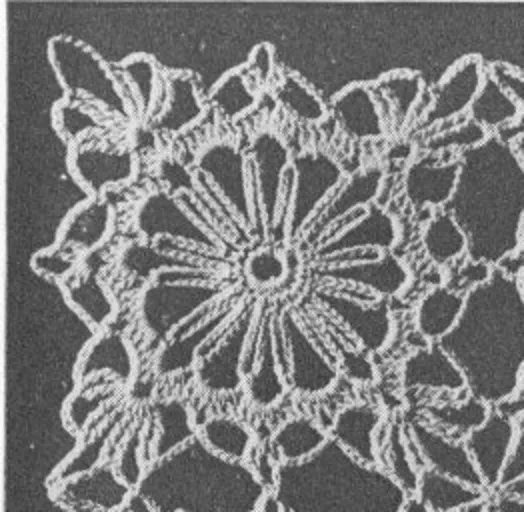
A small square motif from a 1948 booklet of flower tablecloths, five rounds from start to finish. Sixteen long chain loops ray out from a ring like daisy petals, a round of shells ties their tips together, and four tall corner groups square it off. Each motif is about 2 1/2 inches; the booklet joins 660 of them into a cloth.
- Thread
- Size 20 cottonStar in 1948
- Hook
- 1.1 mm steelNo. 11 in 1948
- Finished
- 2 1/2 in square5 rounds

Chart
Daisy Tablecloth Motif crochet chart


Reading this chart
- Start at the center and read each round counterclockwise, the way a right-handed crocheter works.
- Start at the center and read each round clockwise, the way a left-handed crocheter works.
- Each round begins at its green mark, its first stitch or chain; its number is printed beside it. Rounds alternate dark and blue so they read apart.
- The key under the chart names every symbol. Symbols follow the Craft Yarn Council chart standard.
Drawn by Krowshea from the checked counts, not traced from the original. New to charts? How to read crochet charts.
Written pattern
Round by round
Written in US crochet terms
- 1
Ch 8, join with a sl st to the first ch to form a ring, ch 1 (does not count as a st), 16 sc in ring, join with a sl st to the first st.
16 sc - 2
With the hook still in the joining stitch, [ch 16, sc in next st] 15 times, ch 8, join with dtr in the joining stitch (this forms the final sp and leaves the hook in that sp).
15 sc, 16 sps - 3
With the hook still in the joining stitch, [ch 6, sc in next sp] 15 times, ch 3, join with dc in the same space (this forms the final sp and leaves the hook in that sp).
15 sc, 16 sps - 4
Ch 3 (counts as a dc), ch 3, 3 dc over the joining dc, [(3 dc, ch 3, 3 dc) in next sp] 15 times, 2 dc in same sp as first sts, join with a sl st to the top of the beginning ch-3.
96 dc, 16 sps - 5
Sl st in next sp, ch 5 (counts as a dtr), (dtr, ch 5, 2 dtr, ch 11, 2 dtr, ch 5, 2 dtr) in same sp, [ch 5, sc in next sp, ch 5, vee in next sp, ch 5, sc in next sp, ch 5, corner in next sp] 3 times, ch 5, sc in next sp, ch 5, vee in next sp, ch 5, sc in next sp, ch 5, join with a sl st to the top of the beginning ch-5. Fasten off.
32 dtr, 8 sc, 16 dc, 32 sps
Weave in the ends.
Written in UK crochet terms
- 1
Ch 8, join with a ss to the first ch to form a ring, ch 1 (does not count as a st), 16 dc in ring, join with a ss to the first st.
16 dc - 2
With the hook still in the joining stitch, [ch 16, dc in next st] 15 times, ch 8, join with trtr in the joining stitch (this forms the final sp and leaves the hook in that sp).
15 dc, 16 sps - 3
With the hook still in the joining stitch, [ch 6, dc in next sp] 15 times, ch 3, join with tr in the same space (this forms the final sp and leaves the hook in that sp).
15 dc, 16 sps - 4
Ch 3 (counts as a tr), ch 3, 3 tr over the joining tr, [(3 tr, ch 3, 3 tr) in next sp] 15 times, 2 tr in same sp as first sts, join with a ss to the top of the beginning ch-3.
96 tr, 16 sps - 5
Ss in next sp, ch 5 (counts as a trtr), (trtr, ch 5, 2 trtr, ch 11, 2 trtr, ch 5, 2 trtr) in same sp, [ch 5, dc in next sp, ch 5, vee in next sp, ch 5, dc in next sp, ch 5, corner in next sp] 3 times, ch 5, dc in next sp, ch 5, vee in next sp, ch 5, dc in next sp, ch 5, join with a ss to the top of the beginning ch-5. Fasten off.
32 trtr, 8 dc, 16 tr, 32 sps
Weave in the ends.
The 1948 original
As it was printed
New Tablecloths · Daisy Tablecloth
Ch 8, join to form a ring, ch 1 and work 16 s c in ring, join in 1st s c. 2nd Row—* Ch 16, s c in next s c, repeat from * 14 times, ch 7, tr tr c (4 times over needle) in joining, this brings thread in position for next row. 3rd Row—* Ch 6, s c in next loop, repeat from * 14 times, ch 3, d c in tr tr c. 4th Row—Ch 6, 3 d c in same loop, * 3 d c, ch 3, 3 d c in next loop, repeat from * 14 times, 2 d c in 1st loop, join in 3rd st of ch. 5th Row—Sl st to loop, ch 5, d tr c (3 times over needle) in same space, ch 5, 2 d tr c in same space, ch 11, 2 d tr c in same space, ch 5, 2 d tr c in same space, * ch 5, s c in next loop, ch 5, 2 d c, ch 5, 2 d c in next loop, ch 5, s c in next loop, ch 5, 2 d tr c, ch 5, 2 d tr c, ch 11, 2 d tr c, ch 5, 2 d tr c in next loop, repeat from * twice, ch 5, s c in next loop, ch 5, 2 d c, ch 5, 2 d c in next loop, ch 5, s c in next loop, ch 5, join in 5th st of ch, break thread.
The booklet is written in modern American terms (s c, d c, d tr c, tr tr c) and prints the wraps for the tall stitches, so nothing needs translating. It calls each round a "row".
What we checked
- Round 1: 16 sc in the ring.
- Round 2: 16 loops of 16 chains, one from each sc.
- Round 3: 16 ch-6 loops, one tying the tip of each petal to the next.
- Round 4: a shell of 3 dc, ch 3, 3 dc in each of the 16 loops (96 dc).
- Round 5: 4 corners of 8 dtr (32 dtr), and on each side a sc, a V of 2 dc, ch 5, 2 dc, and a sc. The 16 shells divide as 4 corners, 4 V's and 8 sc.
- Every round closes evenly, and the photo shows the same 16 petals and 4 corners.
How we read the old wording
- Round 2 closes with "ch 7, tr tr c in joining", a triple treble that stands for the second half of the last loop. Krowshea's joining stitches go up to the double treble, so our written round has ch 8 and a double treble there: one more chain for a stitch one wrap shorter. Work the booklet's ch 7 and triple treble if you prefer; the loop comes out the same length.
- Round 3 closes the same way with "ch 3, d c in tr tr c". That dc is half of the last loop and is not counted as a stitch.
- Round 4: "Ch 6, 3 d c in same loop" is a dc, ch 3 and 3 dc; the "2 d c in 1st loop" at the end finish that first shell.
- Round 5: the ch 5 that opens the first corner stands for the first of its 8 dtr.
- The booklet goes on to join each new motif to the last in round 5. This page covers the single motif.
No errors in the original. It prints no stitch counts; every round closes evenly.
More vintage patterns
-
 1915 · Motifs
Anne Orr's Medium Medallion
Anne Orr, Center Pieces and Lunch Sets in Crochet Work
-
 1962 · Motifs
Snowflake Doily Motif
Modern Handcraft, Inc., Kansas City, Missouri, The Workbasket, April 1962 (27th Year, Number 7)
-
 1956 · Motifs
Star of Bethlehem Hexagon Motif
Modern Handcraft, Inc., Kansas City, Missouri, The Workbasket, December 1956 (22nd Year, Number 3)
-
 1941 · Motifs
Ballerina Motif
The Spool Cotton Company, Old and New Favorites: Crochet Designs
Krowshea is in beta
Make it with Krowshea
This pattern stays free right here. Krowshea members will be able to do more with it:
- Turn it in 3D Yarn and watch it grow round by round
- Save it to your Library and make it your own: new colors, a border, a different size
- Track your rounds with Make it, on your phone
- Open it in the Studio: change the thread, size it up in yarn, join motifs